STANDARDS & PROTOCOLS
Precision beyond the formula.
A formula is only as dependable as the quality infrastructure that validates it. We evaluate each development phase across five foundational quality criteria.
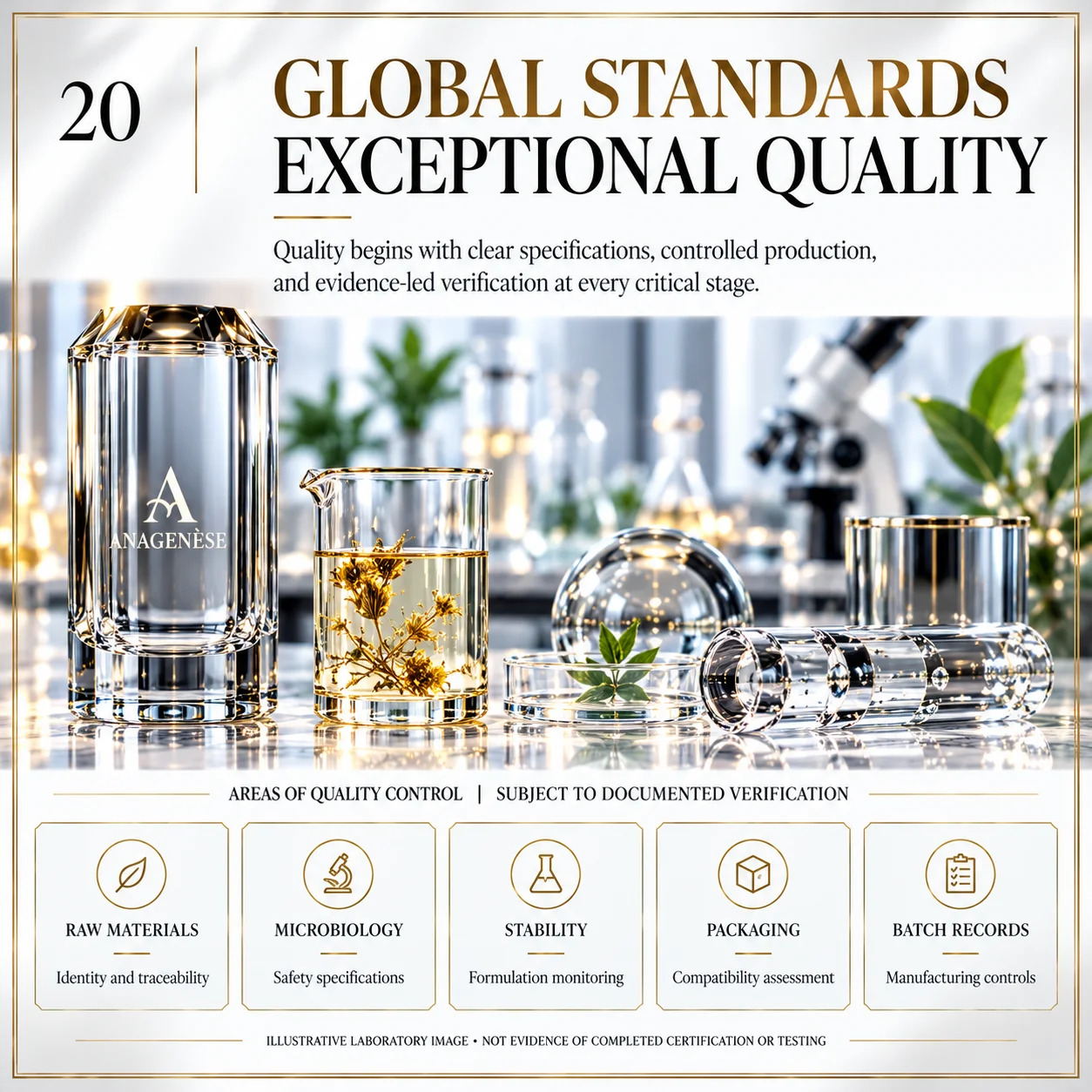
Raw Material Traceability & Purity
Every chemical constituent and botanical extract requires an audited Certificate of Analysis (COA) specifying botanical origin, extraction solvent, active assay percentage, and heavy metal screening (Pb, As, Cd, Hg < 1 ppm).
- HPLC Purity Profiling
- Gas Chromatography for Residual Solvents
- Heavy Metals ICP-MS Screening
Physicochemical Stability Profiling
Testing formulations under accelerated environmental conditions to verify physical phase stability, absence of precipitation, and active molecule longevity over the stated shelf horizon.
- Accelerated Stability: 40°C ± 2°C / 75% RH (12 weeks)
- Freeze-Thaw Cycling: 3 cycles (-10°C to +40°C)
- Centrifugal Stress: 3,000 RPM for 30 minutes
Packaging Compatibility & Migration
Assessing interaction between liquid solution and container materials. Confirming absence of plasticiser leaching from the elastomer bulb and absence of alkali extraction from the borosilicate flacon.
- Sorption & Extraction Analysis
- Drop-Volume Dispersion Consistency (±0.02 mL)
- Spectral UV Transmission Attenuation
Microbiological Preservation Efficacy
Evaluating the preservative architecture against bacterial, yeast, and fungal contamination according to standardized international pharmacopeial challenge protocols.
- ISO 11930 / USP <51> Preservative Challenge
- Inoculation log-reduction monitoring at 7, 14, and 28 days
- Water Activity (Aw) and physiological pH buffering
Analytical Release Specifications
Pre-release verification confirming that each compounded batch matches the analytical master formula within defined standard deviation limits before packaging release.
- Potentiometric pH Verification (5.30 – 5.50)
- Brookfield Viscometry (12.0 – 16.0 cPs)
- Pycnometric Specific Gravity (1.015 – 1.025 g/cm³)